The Complete Guide to Petroleum Waxes: Understanding Paraffin, Semi-Refined, and Slack Wax Grades in Global Supply Chains
Wax is hiding in plain sight. It is in the candle burning on your dinner table, in the coating on your fresh fruit, in the lipstick in your bag, in the tyres on your car, in the cardboard box your last delivery arrived in, and in the asphalt under every road you drive on. Petroleum […]
 The Daily Beat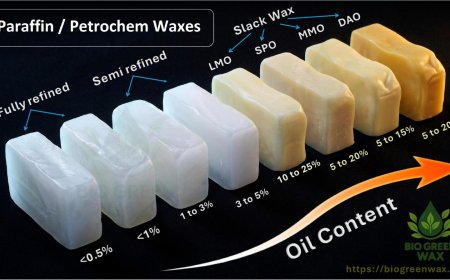
Wax is hiding in plain sight. It is in the candle burning on your dinner table, in the coating on your fresh fruit, in the lipstick in your bag, in the tyres on your car, in the cardboard box your last delivery arrived in, and in the asphalt under every road you drive on. Petroleum wax — derived as a byproduct of lubricating oil refining — is one of the most ubiquitous industrial raw materials on Earth, yet outside of specialist commodity circles, it is also one of the least understood.
This guide is written for procurement professionals, product developers, supply chain managers, and anyone new to the wax market who needs a reliable reference for understanding what separates one petroleum wax grade from another, why those differences matter, and how to specify the right grade for any given application.
Petroleum wax underpins dozens of industries most people interact with every day — yet the knowledge that experienced traders take for granted is rarely written down in one accessible place.
1. What Is Petroleum Wax and How Is It Made?
Petroleum wax is a solid or semi-solid mixture of hydrocarbon chains, produced as a byproduct of the lubricating oil refining process. When crude oil is refined into lubricating oil, the heavier fractions must be chilled and filtered to remove the wax content that would otherwise cause the oil to solidify at low temperatures. This process — known as solvent dewaxing — uses chilled solvents such as methyl ethyl ketone (MEK) or propane to crystallise the wax, which is then separated by filtration or centrifuge.
The resulting raw wax stream is called slack wax — a semi-solid mixture of wax and residual oil. Depending on how much oil is subsequently removed through further processing (deoiling), the product can range from high-oil slack wax all the way to near-pure, water-white fully refined paraffin wax. The degree of refining, the specific distillate fraction it comes from, and the residual oil content all determine which commercial grade the wax becomes.
The major commercial petroleum wax families are: Fully Refined Paraffin Wax, Semi Refined Paraffin Wax, and Slack Wax — the latter of which is further sub-classified into LMO, SPO, MMO, and DAO grades depending on the lubricating oil distillate fraction from which it originates.
2. The Wax Spectrum: Grade by Grade
The most useful way to understand petroleum wax grades is to think of them as a spectrum, running from the most refined (lowest oil content, lightest colour) to the least refined (higher oil content, darker colour).
Fully Refined Paraffin Wax
Fully Refined Paraffin Wax (FRPW) is the most processed and purest form of petroleum wax, with an oil content below 0.5%. It appears as a bright white, odourless solid with a smooth crystalline texture. Melting points range from 48°C to 68°C depending on grade. Its low oil content and white appearance make it the only petroleum wax grade approved for direct contact with food, pharmaceuticals, and cosmetics in most regulatory frameworks, including FDA 21 CFR and EU regulations.
Common applications include food coatings and glazing (cheese, fruit, confectionery), pharmaceutical tablet coatings and ointment bases, premium scented candles (where colour and cleanliness matter), cosmetic formulations including lip balms and creams, paper and board coatings, and electrical insulation.
Semi Refined Paraffin Wax
Semi Refined Paraffin Wax retains slightly more oil than fully refined grades, typically less than 1% or between 1% and 3% depending on the sub-grade. It has an off-white to slightly creamy appearance and is the workhorse grade for general industrial applications where food-grade certification is not required. It burns cleanly enough for candle manufacturing while offering a cost advantage over fully refined grades.
Applications include standard candle manufacturing (the most widely used grade globally for candle production), paper and corrugated board waterproofing coatings, rubber processing as an anti-ozonant, match manufacturing, and packaging laminates.
The Slack Wax Family: LMO, SPO, MMO, and DAO
Slack wax grades are the least refined petroleum wax products — they retain significant quantities of residual oil and are not suitable for food or direct cosmetic contact without further processing. Their value lies in their cost-effectiveness, versatility as industrial raw materials, and their role as feedstocks for further refining into higher-value products. They are classified by the lubricating oil distillate fraction from which they originate, each with distinct physical properties.
Slack Wax LMO — Light Machine Oil
LMO is the lightest slack wax grade, derived from the light machine oil fraction of lubricating oil refining. It exhibits a near water-white to very pale straw-yellow colour (ASTM D-1500 maximum L1.0) and has a melting point of 47–53°C — the lowest of the
four slack wax grades. With an oil content of 10–25% in Bio Green Wax’s customised specification, LMO offers good fluidity at elevated temperatures, making it easy to handle, pump, and blend in industrial processing environments.
LMO’s relatively light colour and low melting point make it the preferred slack wax grade for candle manufacturing where a degree of colour neutrality is desirable, for match and firelighter impregnation, for MDF and particleboard waterproofing treatments, for paper and board moisture-barrier coatings, and as a feedstock for deoiling operations producing fully refined paraffin.
Slack Wax SPO — Spindle Oil
SPO is derived from the spindle oil fraction — historically the lubricating oil used in textile mill spindles and precision machinery. It is the second lightest grade with a pale to light yellow colour (ASTM ≤ 1.5) and a melting point of 53–58°C. Bio Green Wax’s SPO carries an oil content range of 5–20%, giving it a balanced, moderately soft character that makes it the most widely traded slack wax grade globally due to its broad compatibility across different industries.
SPO is used across candle manufacturing as a base and blending wax, shoe and floor polishes, MDF and plywood waterproofing, laminate and paper coatings, textile finishing agents, rubber processing, fertiliser anti-caking coatings, and wax emulsion production. Its combination of accessibility and versatility makes it a staple in the wax trading market.
Slack Wax MMO — Medium Machine Oil
MMO represents a significant step up in both molecular weight and colour intensity. Derived from the medium machine oil fraction, it exhibits a striking golden to dark amber colour (ASTM ≤ 4.5) that immediately distinguishes it from the lighter grades on visual inspection. Its melting point of 58–64°C and viscosity of 8.3–9.4 cSt at 100°C are roughly double those of LMO, reflecting a heavier molecular structure. Bio Green Wax’s MMO carries an oil content of 5–15%.
MMO’s most commercially significant application is as primary feedstock for emulsifying wax (E-wax) production — a critical ingredient in creams, lotions, and personal care emulsions manufactured globally. Beyond cosmetics, MMO serves hot-melt adhesive and sealant formulations, rubber and tyre manufacturing, textile waterproofing, heavy-duty industrial and anti-corrosion coatings, and wax dispersion manufacturing.
Slack Wax DAO — Deasphalting Oil
DAO is the heaviest and most complex slack wax grade, derived from the deasphalting oil fraction — a product of propane or butane solvent treatment of vacuum residue to remove asphaltenic compounds. It has a distinctive dark amber to light brown colour (ASTM ≤ 5.0), a high melting point of 69–74°C, and a viscosity of 18.5–22.5 cSt at 100°C — approximately five times that of LMO. Bio Green Wax’s DAO specification carries an oil content of 5–20%.
DAO’s most strategically important application is as primary feedstock for microcrystalline wax — a highly refined, fine-crystalline wax used in pharmaceuticals (tablet coatings, ointment bases), premium cosmetics, food coatings, electrical cable insulation, and precision adhesive applications. DAO is also used in heavy rubber and tyre compounding, construction waterproofing membranes, pipeline anti-corrosion coatings, and bitumen modification.
An important note for buyers: despite its dark appearance, DAO produces a lighter, refined end product after deoiling and hydrofinishing — making appearance at the slack wax stage an unreliable guide to the quality of what can be produced from it downstream.
3. Understanding Colour and Its Relationship to Grade
The ASTM D-1500 colour scale, measured using a comparator instrument with standardised glass colour chips, is the universal language for describing petroleum wax colour in the trade. The scale runs from 0 (water-white) to 8 (very dark brown). It is important to understand that colour in petroleum wax is not merely cosmetic — it is a proxy for the concentration of polycyclic aromatic hydrocarbons, the degree of refining, and the molecular weight of the wax fraction.
A lighter colour generally indicates lower aromatic content, greater refining, and suitability for more sensitive applications. A darker colour indicates higher molecular weight components and residual aromatics — which, while unsuitable for food or cosmetic contact, carry specific industrial value in rubber, construction, and anti-corrosion applications where those heavier molecular structures contribute useful performance properties.
Colour in petroleum wax is not merely cosmetic — it reflects molecular weight, refining depth, and suitability for downstream applications.
4. What Supply Chain Professionals Need to Know
Sourcing petroleum wax effectively requires more than selecting a grade name. Here are the key parameters every procurement professional should request and understand:
- Certificate of Analysis (CoA): Always request a grade-specific CoA from your supplier covering ASTM colour (D-1500), melting point (D-87), congealing point (D-938), oil content (D-721), viscosity at 100°C (D-445), flash point (D-93), specific gravity (D-1298), and sulphur content (D-1552). Reliable suppliers will provide this as standard.
- Oil Content Range vs Maximum: Standard Pertamina specification sheets express oil content as a maximum percentage. Many suppliers, including Bio Green Wax Ltd, operate to tighter customised ranges — which is important for process consistency. Always confirm whether the figure quoted is a maximum or an operating range.
- Melting Point and Congealing Point: These two values bracket the wax’s solid-liquid transition range. For applications requiring precise pour temperatures (candle making, coatings), both values should be specified and tested on each batch.
- Sulphur Content: LMO carries a higher maximum sulphur allowance (0.30%wt) compared to the other three slack wax grades (0.20%wt). In rubber and tyre applications, elevated sulphur can interfere with vulcanisation — confirm sulphur limits with your technical team before specifying.
- Trade Terms (Incoterms): FOB pricing places freight and insurance risk on the buyer from the loading port. CIF includes freight and insurance to destination port. DDP (Delivered Duty Paid) is the most buyer-friendly term — the supplier assumes all freight, insurance, export clearance, and import duties to the named destination. Clarify which term applies before comparing supplier quotes.
Minimum Order Quantity (MOQ): Slack wax grades are typically traded in metric ton quantities. Industrial buyers should clarify whether pricing is per MT on an
- FCL (full container load) or LCL (less than container load) basis, as freight economics differ significantly.
5. Choosing the Right Grade for Your Application
As a quick guide for buyers evaluating which grade fits their need:
Premium candles, food, cosmetics, pharma → Fully Refined Paraffin Wax
Standard candles, general industrial coatings → Semi Refined Paraffin Wax
Matches, MDF waterproofing, paraffin feedstock → Slack Wax LMO
Polishes, particleboard, rubber, fertiliser coatings → Slack Wax SPO
Emulsifying wax for cosmetics, adhesives, textiles → Slack Wax MMO
Microcrystalline wax feedstock, tyres, anti-corrosion, construction → Slack Wax DAO
About Bio Green Wax Ltd
Bio Green Wax Ltd is a UK-registered global B2B supplier of industrial waxes, oleochemicals, and edible oils, headquartered in London. The company supplies the full spectrum of petroleum wax grades — including fully refined and semi refined paraffin wax, and all four slack wax grades (LMO, SPO, MMO, and DAO) — alongside plant-based waxes, vegetable oils, and specialty oleochemicals to manufacturers and traders across Europe, the Middle East, Asia, and Africa.
Flexible shipping terms (FOB, CIF, DDP) are available, with full CoA and compliance documentation provided for every shipment. For product enquiries, sample requests, or sourcing discussions, visit www.biogreenwax.com or contact the team at info@biogreenwax.com.
Author Note
This article was produced by Bio Green Wax Ltd. Technical data references Pertamina Cilacap Refinery specification sheets (ASTM D-1298, D-445, D-93, D-721, D-87, D-938, D-1552, D-1500). Oil content figures reflect Bio Green Wax Ltd’s customised product specifications. This article is intended for general industry education and should not replace supplier-specific CoA data in procurement decisions.