Sneha Jain's Literary Journey Leads to Things We Don't Have Words For
 The Daily Beat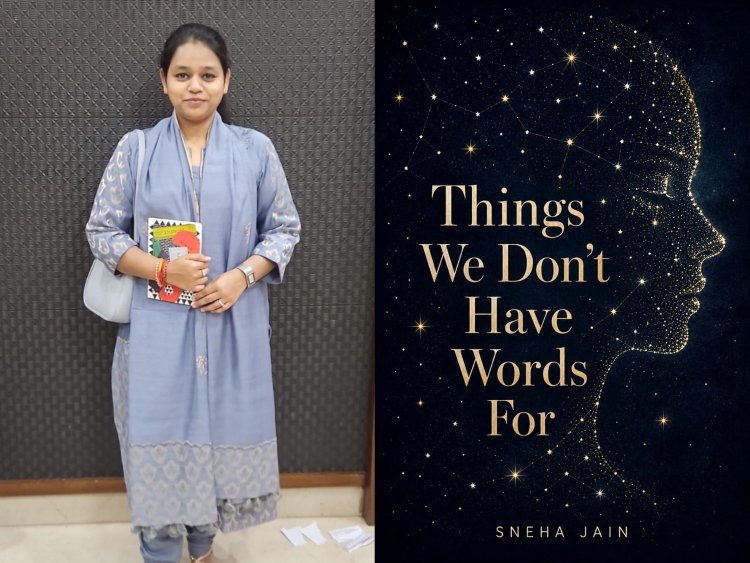
For Sneha Jain, writing is not simply about putting thoughts on a page.
It is about creating a point of connection between one person's inner world and another person's understanding.
That philosophy sits at the heart of Things We Don't Have Words For, her latest book and a collection of 730 original emotional reflections exploring the experiences people often struggle to articulate.
Jain arrives at this work with a literary journey that already spans 13 books.
Her writing has explored identity, resilience, relationships, women's experiences and the quieter realities of being human. Across these subjects runs a consistent interest in the emotional experiences that shape people but are not always openly discussed.
She describes her underlying belief simply: sometimes, being understood begins with finding the right words.
Things We Don't Have Words For takes that belief and builds an entire book around it.
Sneha Jain's professional identity is equally diverse. She is an author, counselling psychologist, mindset coach, motivational speaker and youth mentor. Her work lies at the intersection of words, emotions and human connection.
That intersection becomes especially relevant in a book concerned with feelings that do not fit neatly into conventional descriptions.
Consider the emotional complexity of outgrowing someone once deeply loved.
Or the loneliness of being surrounded by people who know your name but do not truly know you.
Or the guilt that can accompany wanting something for yourself.
Or the nostalgia attached to a version of yourself that you did not realise you were leaving behind.
These experiences are not unusual.
What is unusual is finding precise language for them.
Jain's latest book explores this gap.
The reflections move across love, loss, change, belonging, memory, identity, healing, ambition, hope, loneliness and relationships. Rather than reducing these subjects to straightforward lessons, the collection allows their complexity to remain intact.
That approach reflects the broader character of Jain's work.
Her counselling background includes an approach informed by CBT, REBT and solution focused counselling. She also works in mindset and personal growth and has experience as a youth mentor. Alongside these areas, she is a Food Nutrition Consultant and has contributed to research and collaborative literary projects.
Her work has received 48 national and international honours, including recognition through the India Book of Records and the Pillar of the Nation Award.
Yet the significance of Things We Don't Have Words For does not rest only on awards, professional credentials or the number of books she has written.
Its significance lies in the subject it chooses to examine.
There is a growing tendency to describe emotional life through simplified language. People are often encouraged to identify an emotion quickly, solve a problem and move forward.
Real life is rarely that straightforward.
A person can experience relief and sadness at the same time.
They can want change while fearing it.
They can miss someone without wanting them back.
They can be grateful for their past while refusing to return to it.
They can feel hopeful about the future while grieving something they have lost.
These emotional combinations are part of ordinary human life.
Jain's writing gives them space.
The 730 reflections in Things We Don't Have Words For are therefore not simply a collection of observations. Together, they form an exploration of the language surrounding human emotion.
The book does not instruct its readers on what they must feel.
It asks them to pause and recognise what they already feel.
That distinction gives the work a quiet strength.
The reader is not treated as someone who needs to be fixed. Instead, the reader is invited into a process of recognition.
For someone who has ever struggled to explain an emotion, that can be meaningful.
A feeling becomes less isolating when it can be named.
An experience can become easier to understand when another person has articulated something close to it.
And a reader can sometimes feel seen without ever having spoken directly to the writer.
This is the literary space Sneha Jain hopes to create.
Not a space built only around advice.
Not a collection designed simply to motivate.
A space where people can pause, feel seen and find language for the parts of themselves they have struggled to explain.
With Things We Don't Have Words For, Jain's work as an author takes a deeply introspective direction. The result is a book rooted in emotions that are universal, complicated and often difficult to name.
Sometimes the most meaningful discovery in a book is not a solution.
It is recognition.
The realisation that somewhere, at some point, someone else has felt it too.
Amazon Link: https://www.amazon.in/Things-We-Dont-Have-Words/dp/9379033621